
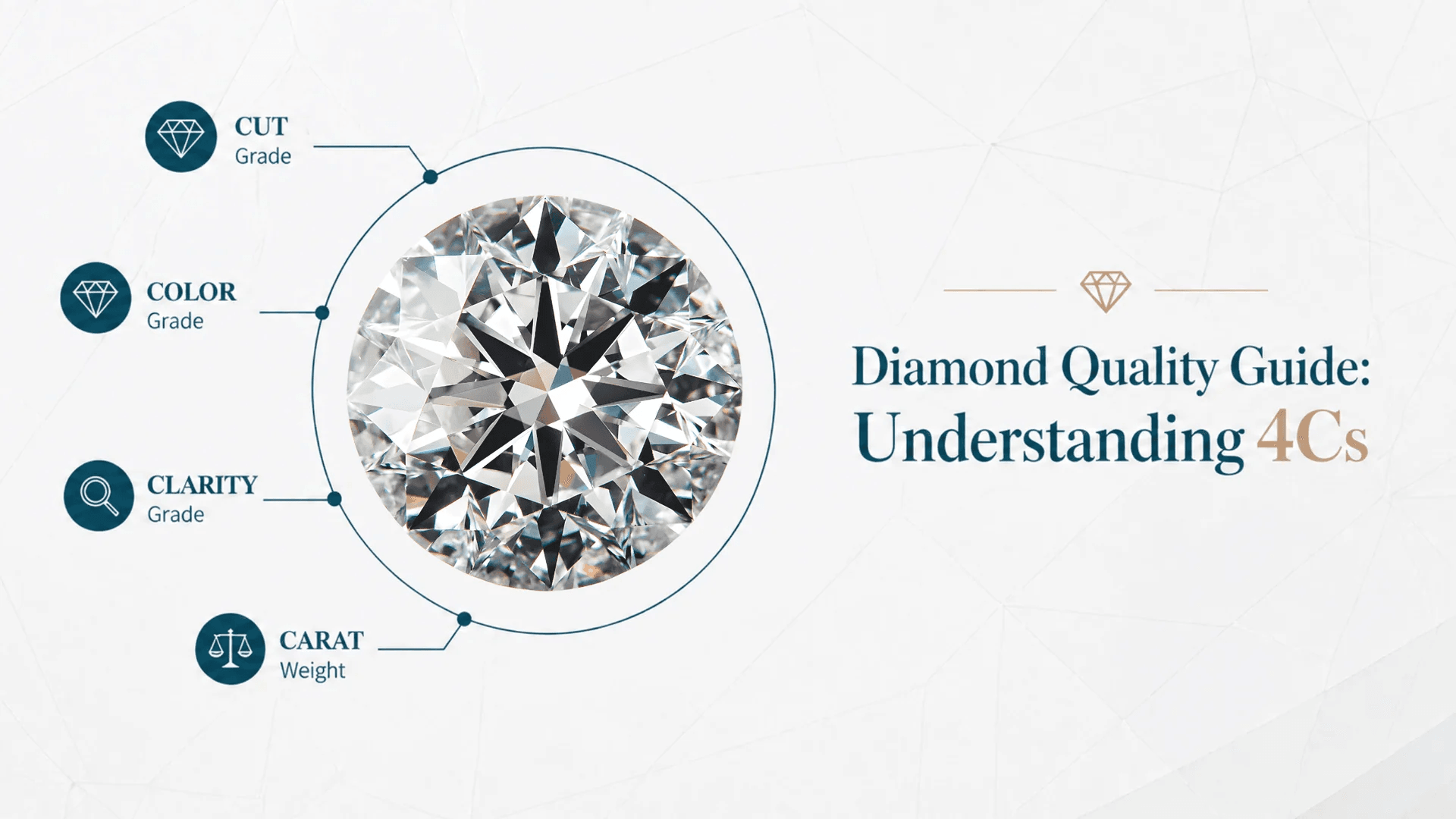
Why the 4Cs Are Non-Negotiable for B2B Buyers
The Gemological Institute of America introduced the 4Cs framework in the 1950s as a standardised language for grading diamonds globally. Today, every B2B transaction — from a loose parcel sourced in Surat to a retail showcase in New York — is anchored in these four parameters.
For wholesale buyers, understanding the 4Cs is not merely academic. It is the foundation for price negotiation, parcel acceptance criteria, customs valuation, and downstream retail positioning. A buyer who cannot read a GIA or IGI grading report fluently is at a systematic disadvantage in every transaction.
Cut: The C That Determines Brilliance
Cut is widely considered the most important of the four Cs because it governs how light travels through a diamond. A well-cut stone reflects light from facet to facet and projects it through the table, creating the fire and brilliance that buyers and consumers associate with premium quality.
GIA grades round brilliants on a five-point scale: Excellent, Very Good, Good, Fair, and Poor. For B2B buyers targeting US and European markets, Excellent-cut round brilliants command a significant premium — often 15–25% above Very Good — but move faster at retail because of their visual impact.
Rachna Export’s cutting facility in Surat's SEZ operates with Sarine 3D rough planning technology, which optimises yield while targeting the Excellent-cut tier for rounds. For fancy shapes such as ovals, cushions, and pears, cut is assessed via proportions and optical symmetry using Sarine DiaMension HD.
Colour: D to Z and Beyond
GIA's colour scale runs from D (colourless) to Z (light yellow or brown). The near-colourless range — G, H, I, J — represents the sweet spot for most wholesale buyers because it offers strong visual appearance at a significantly lower per-carat cost than the D–F colourless tier.
Fancy colour diamonds — natural pinks, blues, yellows, and greens — operate on a completely separate grading scale and represent a distinct, highly speculative market. Rachna Export sources Fancy Yellow and Fancy Intense Yellow natural diamonds on request for clients in the UAE and Hong Kong, where fancy colours enjoy particularly strong demand.
Lab grown diamonds are routinely produced in the D–F colour range at a fraction of the cost of natural equivalents, making them attractive for buyers targeting price-sensitive markets without sacrificing visual grade.
Clarity: Inclusions, Blemishes, and What Actually Matters
Clarity grades range from Flawless (FL) — no inclusions visible under 10x magnification — to Included (I3), where inclusions are visible to the naked eye. For most B2B parcel buyers, the SI1–VS2 range delivers the optimal cost-to-appearance ratio.
Eye-clean SI1 stones are among the most efficient purchases in the wholesale market: they appear flawless to consumers without magnification but carry none of the FL/IF premium. Rachna Export's quality team, led by GIA Graduate Gemologist Priya Shah, grades every stone above 0.30 ct in-house before third-party certification.
Buyers should be particularly cautious with SI2 grades, which can range from eye-clean to visibly included depending on inclusion type and position. Always request a grading report image or loupe inspection for SI2 and below before committing to a parcel.
Carat Weight: Price Per Carat and the Magic Sizes
Carat is a unit of mass — one carat equals 0.2 grams. Price per carat rises non-linearly with carat weight because larger rough crystals are rarer. The diamond trade refers to “magic sizes” — 0.50 ct, 0.75 ct, 1.00 ct, 1.50 ct, 2.00 ct — where demand and premiums spike sharply.
For wholesale buyers, sourcing stones just below magic sizes (e.g., 0.48–0.49 ct instead of 0.50 ct) can yield significant cost savings with minimal perceptible difference in a finished piece. Rachna Export regularly sources these “just-under” parcels on request.
Total carat weight (TCW) is used when describing multi-stone settings or mixed parcels. When evaluating TCW offers, always request a breakdown by individual stone distribution — a parcel averaging 1.00 ct TCW can be composed of very different size distributions with very different per-stone values.
Combining the 4Cs: A Practical Decision Matrix for Buyers
Experienced wholesale buyers rarely optimise for a single C. Instead, they identify the minimum acceptable threshold for each parameter given their end-market's expectations and their margin requirements. A US fine jeweller targeting bridal may require Excellent cut, G–H colour, VS2–SI1 clarity, and 0.90–1.10 ct. A fashion jeweller sourcing for volume may accept Very Good cut, I–J colour, SI1–SI2, and 0.40–0.60 ct.
Rachna Export’s sales team works with each buyer to map their customer profile to a specific 4C window, then sources or allocates parcels accordingly from our monthly throughput of 10,000+ stones. Contact us to discuss your specification.