
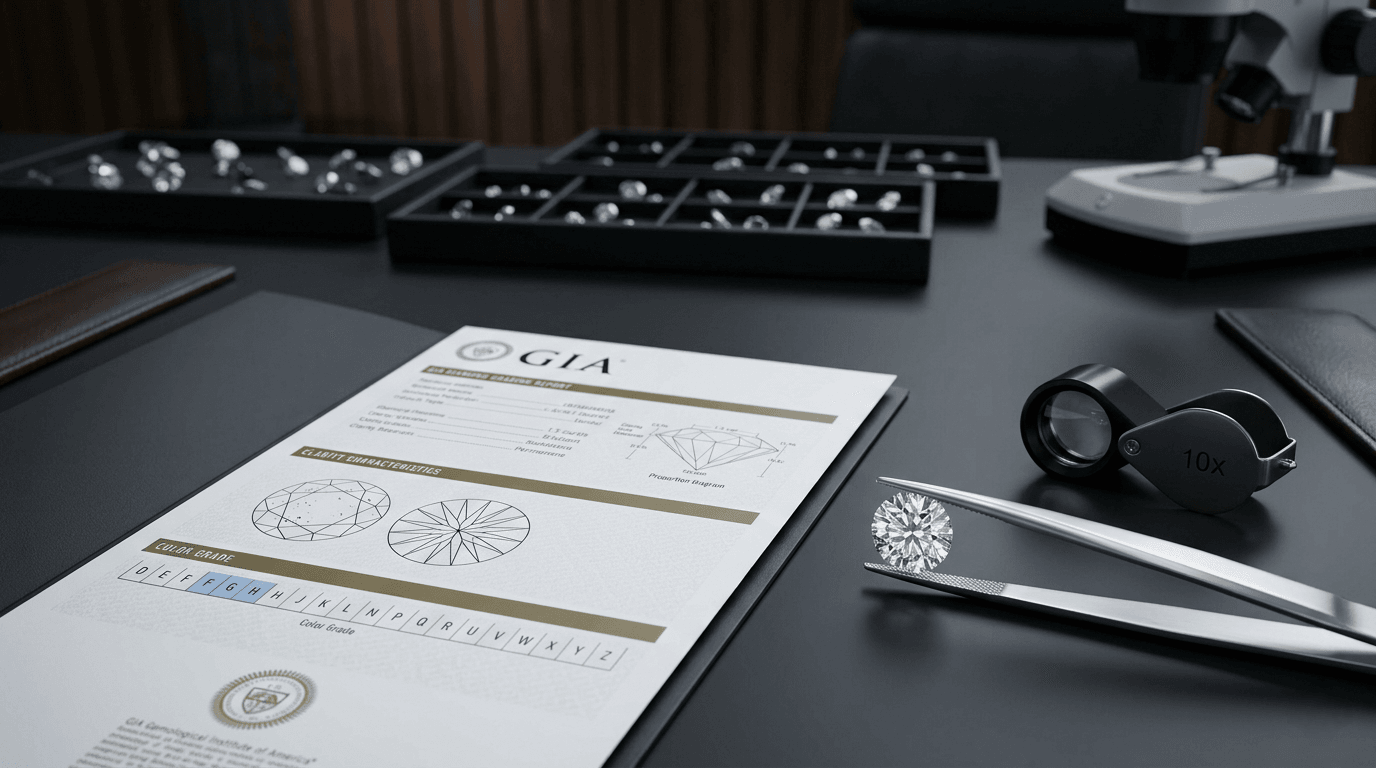
GIA Dossier vs Full Grading Report: Which Do You Need?
GIA issues two primary report types for natural round brilliant diamonds: the Dossier (for stones 0.15–1.99 ct) and the Full Grading Report (for stones 2.00 ct and above, or any fancy shape). The Full Report includes the clarity plot diagram — a map of all inclusions — while the Dossier includes a QR-linked digital record instead of a printed plot. For parcels 0.15–1.99 ct, either is acceptable; above 2.00 ct, insist on the Full Report with plot.
GIA also issues the eReport (digital-only, lower fee) and Origin reports (for tested natural origin claims). For B2B wholesale transactions, the physical or digital Dossier and Full Report are standard.
The Header Fields: Verification First
The GIA Report Number (top right, 10 digits) is your primary verification key. Enter it at GIA Report Check (gia.edu/report-check) to confirm the report is genuine and unaltered. Always verify before committing to a purchase — counterfeit and altered GIA reports exist in the market.
The Shape and Cutting Style field (e.g., “Round Brilliant”) confirms the stone's geometry. The Measurements field (e.g., “6.43 – 6.46 x 3.99 mm”) gives the diameter range and depth for a round; for fancies, it gives length x width x depth. These measurements allow you to verify the stone in hand matches the report.
The 4C Grade Fields
Carat Weight is measured to the nearest 0.01 ct on the report. Actual weight should match within instrument tolerance (±0.01 ct). If a stone consistently weighs less than its certificate, something is wrong.
Color Grade is a single letter (D through Z). For natural fancy colour diamonds, GIA uses a separate Fancy Color Grading Report with hue, tone, and saturation descriptors.
Clarity Grade (FL through I3) is accompanied by the plot diagram on Full Reports. The plot shows the type and position of every inclusion using standardised symbols: a red crystal, a green chip, a black cloud. Learning to read the plot lets you assess whether inclusions are central (problematic) or peripheral (less impactful on brilliance and durability).
Cut Grade applies only to standard round brilliants. It is a composite of Polish, Symmetry, and Proportions grades. An Excellent overall cut requires Excellent or Very Good Polish and Symmetry plus proportions within GIA's Excellent window (table 54–57%, depth 59–62.5%, crown angle ~34–35°, pavilion angle ~40.6–41°).
The Proportions Diagram
The cross-section diagram on the right side of a Full Report shows the stone's actual proportions to scale. Key measurements: Table %, Total Depth %, Crown Angle, Crown Height %, Pavilion Angle, Pavilion Depth %, Girdle thickness, and Culet size.
For round brilliants, use the following benchmark: Table 53–58%, Depth 59–62.5%, Crown Angle 33.7–35.8°, Pavilion Angle 40.6–41.0°, Thin to Slightly Thick girdle, None to Very Small culet. Stones meeting these parameters will have Excellent to Very Good optical performance regardless of their grade label.
Fluorescence: Misunderstood and Over-Priced
Fluorescence describes a stone's visible glow under ultraviolet light. GIA grades it None, Faint, Medium, Strong, or Very Strong, with the dominant colour (usually blue). Strong blue fluorescence in D–F colour stones carries a market discount of 3–10% due to perceived risk of “oily” or “milky” appearance under UV-rich lighting.
In reality, strong blue fluorescence in H–I colour stones can visually improve the stone's face-up colour under natural lighting by counteracting the faint yellow tint. For buyers sourcing G–I colour, Strong Blue fluorescence stones represent a genuine value opportunity that unsophisticated buyers discount unnecessarily.
Rachna Export can source fluorescence-specific parcels on request. Many of our US bridal buyers prefer None to Faint fluorescence for D–F; our fashion buyers routinely take advantage of the fluorescence discount on G–I.