
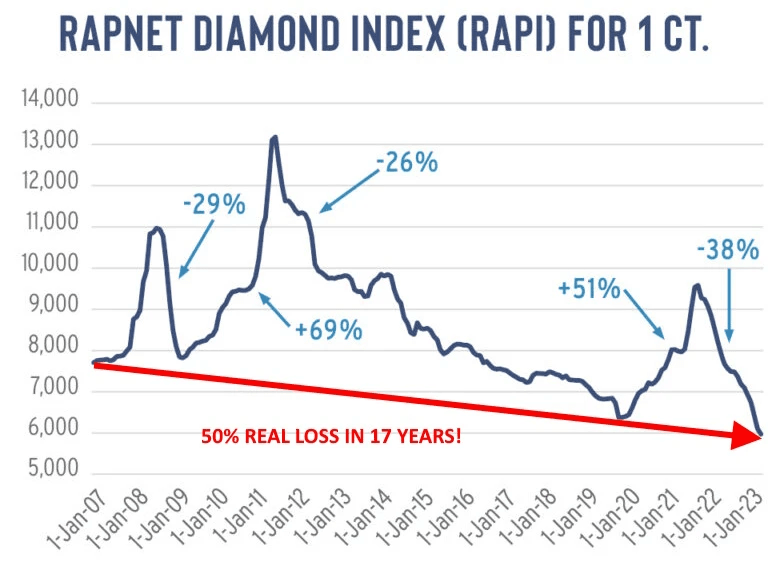
The Numbers: How Far Prices Have Fallen
The price trajectory has been relentless. A 1.00 ct D/VS1 CVD round brilliant that wholesaled for approximately $900–$1,100 per carat in early 2022 now trades at $200–$250 per carat in mid-2026 — a decline of roughly 74% from peak. Larger sizes (2–3 ct) have experienced even steeper percentage drops as production technology has matured to reliably grow bigger stones.
The decline has slowed in early 2026 as prices approach production cost floors. CVD reactor operating costs — energy, seed plates, gas, and labour — establish a natural floor below which manufacturers cannot sell profitably. Current estimates place the floor at approximately $120–$180 per carat for gem-quality 1 ct CVD, suggesting further declines will be more gradual. However, continued efficiency improvements in reactor throughput and energy costs in India’s Gujarat solar belt could push this floor lower still.
The Paradox: Falling Prices, Rising Demand
Despite — or because of — collapsing prices, consumer adoption has surged. Lab grown diamonds now account for over 60% of engagement ring centre stones sold in the United States, up from approximately 17% in 2020. Gen Z and Millennial buyers are driving this shift, prioritising size and visual impact over origin and perceived investment value.
The average lab grown engagement ring centre stone has grown from 1.2 ct in 2022 to 1.8 ct in 2026, as buyers use their savings to upgrade size and quality. This “trade-up” behaviour has created a new market dynamic: consumers are buying significantly larger, higher-quality stones than they could have afforded in natural, effectively expanding the total addressable market for diamond jewellery.
The Retail Markup Gap: Where the Real Opportunity Lives
One of the most notable features of the 2026 market is the persistent gap between wholesale price reality and legacy retail pricing. Many traditional brick-and-mortar retailers continue to price lab grown diamonds at markups of 300–500% over current wholesale — a relic of 2021–2022 pricing structures that have not been adjusted downward.
Direct-to-consumer brands and online retailers have been faster to pass wholesale savings to buyers, creating a two-tier retail market. Wholesale buyers who supply D2C brands are seeing volume growth, while those supplying traditional retail are experiencing margin pressure as consumers comparison-shop online. The strategic opportunity for B2B buyers is clear: align with retail partners who price competitively and move volume, rather than legacy retailers sitting on overpriced inventory.
Natural vs Lab Grown: The 2026 Bifurcation Is Complete
The diamond market has now fully bifurcated into two distinct segments with different value propositions, customer profiles, and pricing dynamics. Natural diamonds are positioned as rare geological assets with heritage, resale, and emotional value. Lab grown diamonds are positioned as beautiful, affordable consumer goods — similar to high-end electronics — with no meaningful resale or investment value.
This bifurcation is healthy for the industry. It eliminates the confusing middle ground where lab grown and natural competed directly on price. Sophisticated retailers and wholesalers now stock both categories, targeting different customer segments with differentiated messaging. Rachna Export operates in both segments with complete transparency: natural parcels are sourced from KP-certified rough with full GIA documentation; lab grown parcels are CVD-grown in our Surat SEZ partner facility with IGI certification.
Strategic Playbook for B2B Buyers in the New Normal
First, accept the new pricing reality and adjust your cost structures accordingly. Lab grown diamonds are now a margin-per-piece business, not a margin-per-carat business. Volume efficiency and fast inventory turnover are the keys to profitability.
Second, diversify across both natural and lab grown. The two segments serve different customers and different occasions. A buyer who only stocks lab grown misses the bridal luxury segment; a buyer who only stocks natural misses the majority of engagement ring sales in 2026.
Third, source from Surat for maximum cost advantage. Indian CVD production is the most cost-efficient in the world, powered by Gujarat’s renewable energy infrastructure. Rachna Export’s lab grown parcels are priced at current market wholesale — not legacy markups — and include IGI certification as standard. Contact us for a same-week quote on your specification.