
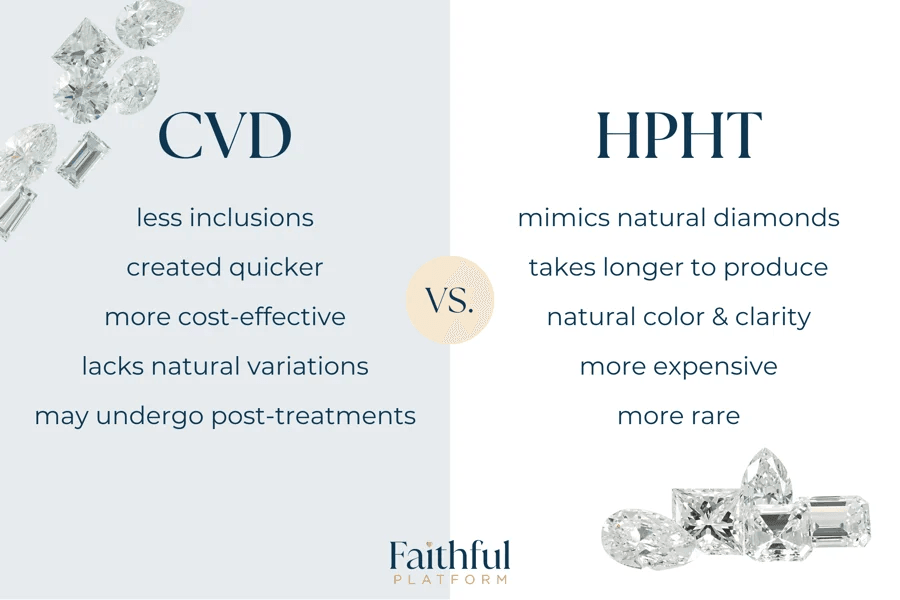
How CVD Works
In Chemical Vapour Deposition, a thin diamond seed plate is placed inside a sealed reactor chamber. A mixture of methane and hydrogen gas is introduced and activated by microwave energy into a plasma state, breaking the methane’s carbon-hydrogen bonds. Carbon atoms deposit layer by layer onto the seed, building up a single-crystal diamond over a growth period of 6–12 weeks.
CVD reliably produces near-colourless to colourless diamonds (D–H range) in the size range most relevant to jewellery (0.50–5.00 ct). The process is scalable, and reactor farms can run multiple growth cycles simultaneously — making Surat’s CVD facilities competitive on throughput and cost.
How HPHT Works
HPHT presses a carbon source — typically graphite — with a metal solvent catalyst at pressures of 5–6 GPa (roughly 50,000 times atmospheric pressure) and temperatures of 1,300–1,600°C. These conditions mimic the mantle environment where natural diamonds form. The carbon dissolves in the molten metal and recrystallises onto a diamond seed.
HPHT is the original lab grown method and is particularly well-suited to producing fancy colour diamonds — yellows, blues, and pinks — through the introduction of boron or nitrogen during growth. It is less efficient than CVD for large near-colourless stones but remains the primary method for fancy colour lab grown production.
Detection and Disclosure
Both CVD and HPHT stones are disclosed on GIA and IGI grading reports. The growth method is listed under “Additional Grading Information.” Advanced detection uses photoluminescence spectroscopy and UV-Vis absorption to identify the characteristic growth patterns of each method.
CVD stones sometimes show a brown or greyish tint post-growth due to structural defects from the deposition process. This can be corrected with a brief HPHT post-growth treatment (annealing), which removes the discolouration. Treated CVD stones are disclosed on the certificate as “CVD, post-growth treated.” Rachna Export’s CVD partner targets D–G colour without post-treatment as a quality benchmark.
Which Should Buyers Specify?
For near-colourless to colourless white diamond parcels (rounds, ovals, cushions, 0.50–3.00 ct): specify CVD. It offers better consistency in the near-colourless range and is the dominant product from Surat’s SEZ facilities.
For fancy colour lab grown diamonds: specify HPHT, particularly for Fancy Intense Yellow and Fancy Blue. These are niche, premium goods with a different demand profile than commodity near-colourless CVD.
From a consumer disclosure perspective, both methods must be disclosed as “laboratory-grown” by FTC rules in the US and equivalent regulations in the EU and UAE. Never present lab grown stones as natural diamonds — this is fraud in every jurisdiction Rachna Export operates in, and we will not participate in undisclosed mixing.