
The Great Decoupling: Two Distinct Markets
The defining characteristic of the diamond industry in 2026 is the complete and irreversible decoupling of natural and lab-grown diamond pricing. Historically, lab-grown diamonds were priced as a fixed discount to natural stones. Today, that correlation has dissolved. Natural diamonds operate within a framework of geological scarcity and aspirational luxury, while CVD (Chemical Vapor Deposition) diamonds function as a technology-driven manufacturing product subject to economies of scale.
This bifurcation means that B2B buyers can no longer treat diamonds as a single monolithic category. Successfully navigating the 2026 market requires two entirely distinct business models, procurement strategies, and retail narratives.
Natural Diamonds: The Resurgence of Scarcity
Following periods of price correction, the natural diamond market has stabilized in 2026. This stabilization is fundamentally driven by constrained rough supply. With the closure of legacy mines (such as Argyle) and a lack of significant new geological discoveries, the pipeline of natural rough diamonds is structurally shrinking.
Top-tier mining conglomerates, including De Beers, have implemented disciplined supply management strategies, refusing to flood the market with rough goods during periods of soft demand. Consequently, natural diamonds—particularly those over 2.00 carats with high color and clarity grades—have solidified their status as premier luxury assets.
For wholesale buyers, the strategy for natural diamonds should focus heavily on provenance, flawless GIA certification, and targeting the ultra-high-net-worth (UHNW) and traditional bridal sectors, where the 'billion-year-old' narrative remains highly compelling.
CVD Lab-Grown: The Democratization of Size
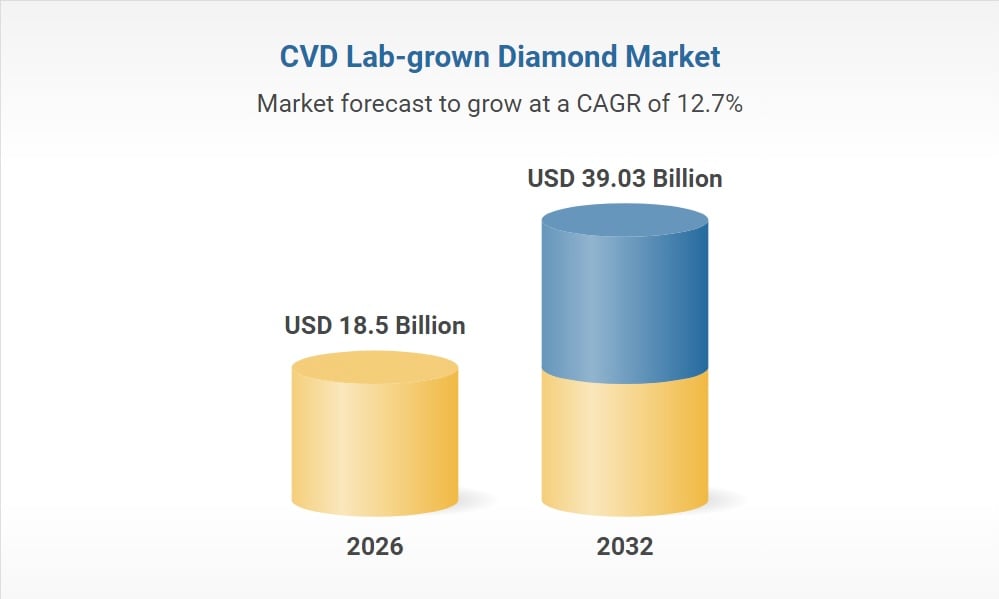
The trajectory of CVD lab-grown diamonds mirrors the technology sector: as manufacturing processes in hubs like Surat have perfected the plasma reactor technology, production yields have skyrocketed and costs have plummeted. The 'Moore's Law' of lab-grown diamonds has resulted in an abundance of high-quality, high-color (D-F) rough.
This cost compression is being passed directly to wholesale buyers. As a result, CVD diamonds are capturing massive market share in the fashion jewelry sector and the entry-to-mid-tier bridal market. Consumers are no longer forced to compromise on the 4Cs; a budget that previously afforded a 0.75ct SI2 natural stone now comfortably secures a 2.50ct VVS1 CVD diamond.
For B2B buyers, CVD represents a high-velocity, high-margin category. Purchasing strategies should optimize for rapid inventory turnover, aggressive marketing, and capturing volume rather than relying on long-term value retention.
The Blurring Lines in Retail Segments
While the supply chains have diverged, retail adoption shows fascinating regional variations. In the US market, lab-grown diamonds now represent nearly half of all engagement ring sales by volume. In contrast, markets in the Middle East and parts of Asia maintain a strong cultural adherence to natural diamonds for significant life events, confining lab-grown stones to travel jewelry and seasonal gifting.
Retailers are adapting by implementing 'multi-tier' showcasing. High-end natural diamonds are presented with elaborate storytelling focusing on rarity and legacy, while CVD diamonds are marketed heavily on aesthetics, size, and sustainability credentials.
Sourcing Strategy for 2026 and Beyond
Wholesale buyers must strictly segment their capital allocation. Natural diamond procurement requires deep capital reserves to hold rare stones that appeal to the inelastic luxury market. CVD procurement requires agility—buying just-in-time inventory to avoid depreciation as manufacturing costs continue to edge downward.
Rachna Export provides comprehensive sourcing solutions for both sectors. Our deep integration with Surat's cutting facilities ensures our partners have priority access to exceptional natural stones, as well as the most competitively priced, premium CVD parcels. By understanding the distinct mechanics of both markets, B2B buyers can maximize profitability across all consumer segments.