
The Mechanics of Brilliance: Proportions Matter
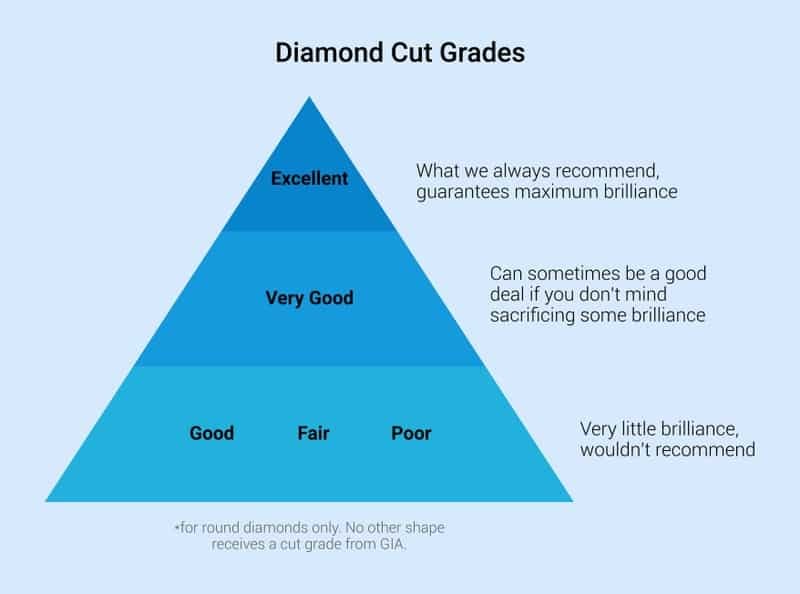
While colour and clarity are dictated by nature, cut is determined by human precision. The GIA Cut grading system (Excellent, Very Good, Good, Fair, Poor) for round brilliants evaluates how successfully a diamond interacts with light to create brightness, fire, and scintillation.
An 'Excellent' cut is not a single set of measurements, but a range of parameters that work together. A table percentage between 54% and 57%, combined with a depth of 61% to 62.5% and a crown angle of 34 to 35 degrees, typically yields optimal light return. Stones falling outside these narrow bands lose light through the pavilion (bottom), resulting in a dull or dark appearance.
For wholesale buyers, understanding these specific percentages is crucial. Two diamonds can both receive an 'Excellent' cut grade on paper, but one cut to absolute ideal proportions will visually outperform a borderline 'Excellent' stone.
The Price Premium for Perfection
Because achieving an Excellent cut requires sacrificing more rough diamond weight during the manufacturing process, these stones command a significant wholesale premium. A cutter must choose between maximizing the final carat weight (often resulting in a Very Good or Good cut) or maximizing optical performance (Excellent cut).
In the 2024-2025 market, retailers are increasingly demanding 'Triple Excellent' (Excellent Cut, Polish, and Symmetry) stones. Consequently, the discount applied to 'Very Good' cuts has widened, making them harder to move in premium retail environments.