What Is Moissanite? Origin and Production
Moissanite is silicon carbide (SiC), a naturally occurring mineral first discovered in 1893 by Henri Moissan in a meteor crater in Arizona. Natural moissanite is extraordinarily rare — virtually all moissanite in the jewellery market is laboratory-created by companies such as Charles & Colvard (the original patent holder, now expired) and numerous Chinese manufacturers.
Modern moissanite is grown using a thermal vapour deposition process at temperatures exceeding 2,000°C. Production has scaled significantly since the original patent expired in 2015, driving wholesale prices down to $20–80 per carat for colourless grades — a fraction of both natural and lab grown diamond prices.
Optical Properties: More Fire, Different Brilliance
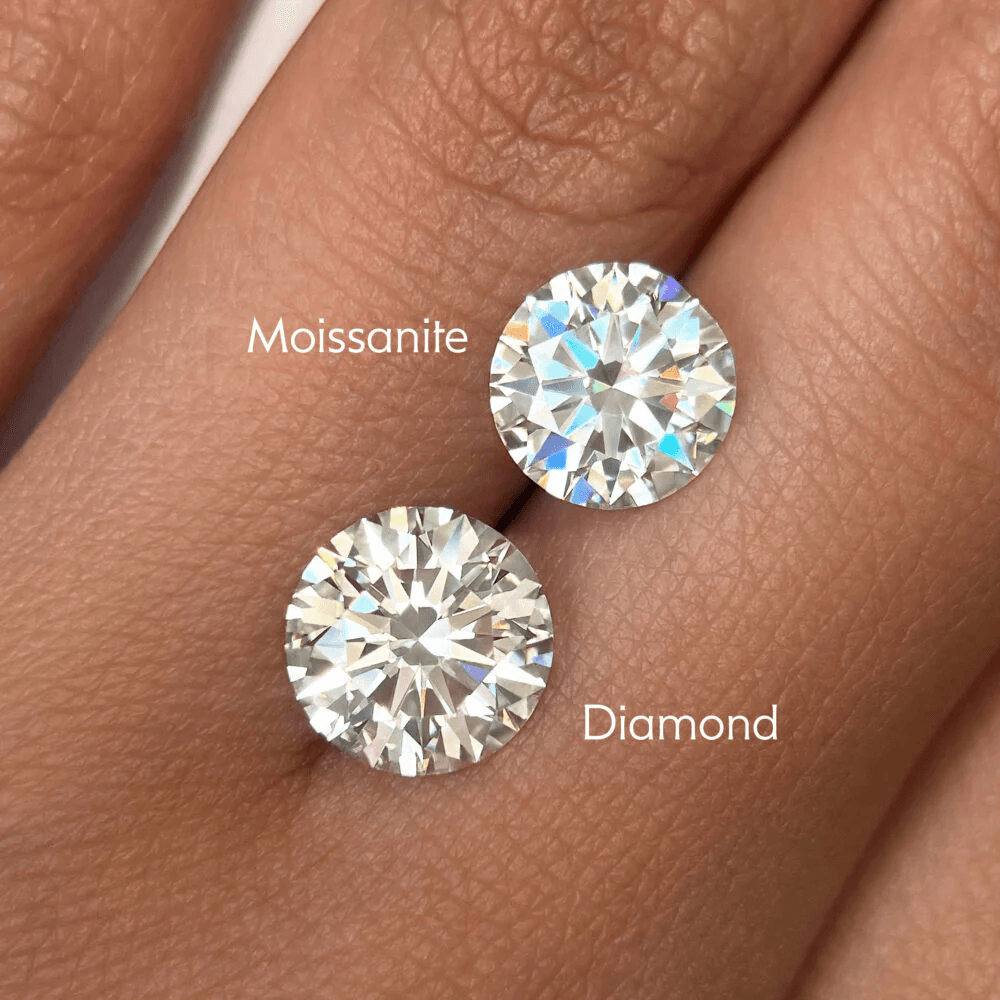
Moissanite has a higher refractive index (2.65–2.69) than diamond (2.42), meaning it bends light more aggressively and produces more fire — the colourful spectral flashes visible when the stone moves. To many consumers, this extra fire is beautiful; to trained eyes, it can appear “rainbow-like” or “disco ball” compared to diamond’s more balanced white light return.
Moissanite is also doubly refractive (birefringent), meaning it splits light into two rays as it passes through the crystal. Under 10x magnification, this creates a visible doubling of back facet edges — the most reliable visual indicator that separates moissanite from diamond. Diamond is singly refractive and shows no facet doubling.
Durability: Nearly Diamond-Hard, But Not Quite
On the Mohs hardness scale, moissanite scores 9.25 compared to diamond’s 10. This makes moissanite the second-hardest gemstone available and extremely scratch-resistant for daily wear. It will not cloud, discolour, or degrade over time. For practical jewellery use, moissanite’s durability is excellent.
However, diamond’s Mohs 10 represents a significant jump in absolute hardness — diamond is roughly four times harder than moissanite despite the close numerical rating. This matters primarily for industrial applications and for jewellers who set and polish stones: moissanite scratches more easily during setting than diamond and requires careful handling during bench work.
Price Positioning and Market Segmentation
Moissanite wholesale prices ($20–80/ct) position it below lab grown diamonds ($200–$400/ct for 1 ct D/VS1 CVD) and far below natural diamonds ($5,500–$7,000/ct equivalent). This creates a clear three-tier market: moissanite for budget-conscious buyers, lab grown for mid-market, and natural for luxury and investment.
For jewellery retailers, moissanite opens a price point below $500 for a 1 ct equivalent solitaire ring — a segment that neither natural nor lab grown diamonds can compete in. However, moissanite carries no resale value and no certification infrastructure comparable to GIA/IGI, which limits its appeal to fashion and self-purchase rather than bridal and gifting in most markets.
Strategic Implications for Diamond Buyers
Moissanite is not a direct competitor to natural diamonds — the markets barely overlap. It does, however, compete with lab grown diamonds at the lower end of the lab grown price spectrum, particularly for fashion jewellery and fast fashion brands seeking maximum margin on stone cost.
Rachna Export’s position is clear: we specialise in certified diamonds — both natural and lab grown — with full GIA/IGI documentation. We do not source or sell moissanite. For buyers seeking diamond alternatives for specific product lines, we recommend transparent disclosure to end consumers and clear brand positioning that does not imply equivalence to diamond.