What Is Diamond Fluorescence?
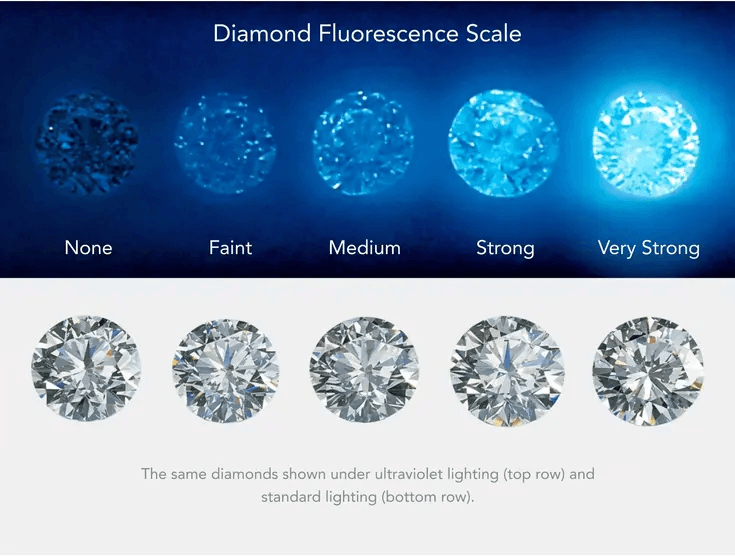
Fluorescence is the visible light some diamonds emit when exposed to ultraviolet (UV) radiation. Approximately 25–35% of natural diamonds exhibit some degree of fluorescence, most commonly blue. GIA grades fluorescence intensity as None, Faint, Medium, Strong, or Very Strong.
Fluorescence is caused by trace elements — primarily nitrogen — in specific structural configurations within the diamond’s crystal lattice. It is a natural phenomenon that occurs during diamond formation over billions of years. Fluorescence is not a treatment, not a deficiency, and not a sign of lower quality — yet the market prices it as though it were.
The Market Discount: What You’ll Actually Pay
Strong blue fluorescence carries consistent market discounts: 10–15% off Rapaport for D–F colourless stones, 5–8% for G–H near-colourless, and negligible to zero discount for I–J and below. Very Strong fluorescence can carry discounts of 15–20% on D–F stones.
These discounts exist because of persistent market perception that fluorescence makes diamonds appear “milky,” “oily,” or “hazy.” This perception dates to the 1990s when certain fluorescent diamonds from specific deposits did exhibit haziness — but GIA’s comprehensive 1997 study of 26,000 diamonds found that fewer than 2% of strongly fluorescent diamonds showed any perceptible haziness, and the majority of observers preferred the appearance of fluorescent stones.
When Fluorescence Actually Helps: The G–I Sweet Spot
For near-colourless diamonds in the G–I colour range, strong blue fluorescence can visually counteract the faint yellow or brown body colour, making the stone appear whiter and more colourless in face-up position under natural and mixed lighting conditions. A G-colour diamond with Strong Blue fluorescence can face up like an E or F under daylight.
This creates a genuine value opportunity: a buyer purchasing a G/VS1/Strong Blue diamond pays G-colour pricing minus the fluorescence discount, while delivering a stone that visually performs like an E or F to the end consumer. For retail markets where consumers evaluate diamonds by eye rather than certificate, this is one of the most efficient value plays in the wholesale diamond market.
When to Avoid Fluorescence: The D–F Caution Zone
For D–F colourless stones destined for investment, collector, or ultra-luxury markets, None to Faint fluorescence is the safer choice. These markets are certificate-driven, and buyers (or their advisors) will note Strong fluorescence and apply discounts regardless of visual performance.
Additionally, the small percentage of strongly fluorescent D–F stones that do exhibit haziness tend to be in this colour range, where the fluorescence interacts visibly with the stone’s already-minimal body colour. While the risk is statistically small (under 2%), the downside of a hazy D-colour diamond is significant enough to warrant caution for high-value singles above 2 ct.
How Rachna Export Sources Fluorescence-Specific Parcels
Rachna Export maintains fluorescence-specific inventory lines for buyers who understand this pricing dynamic. Our “Blue Value” parcels feature G–I colour diamonds with Strong Blue fluorescence at aggressive per-carat pricing — ideal for retail buyers who sell on visual quality rather than certificate grade.
For investment-grade and luxury parcels, we source None to Faint fluorescence across the D–F range as standard. All fluorescence grades are clearly documented on GIA/IGI certificates; we never mix fluorescence grades within a parcel without explicit buyer agreement. Contact our team to discuss fluorescence-specific sourcing for your market.